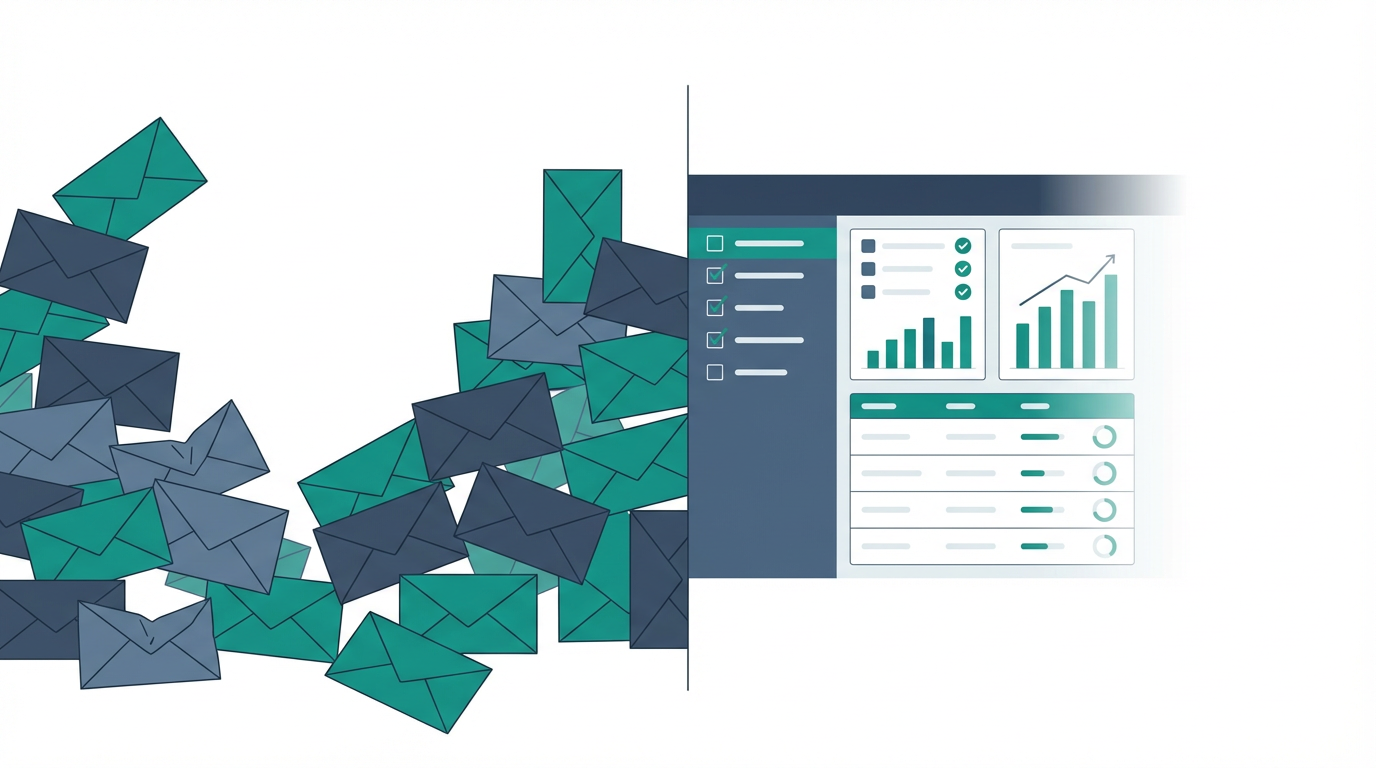

The last week of the month has a rhythm in healthcare AP that every practitioner recognizes. It starts with the inbox. The statements are arriving.
There's the McKesson statement with 63 line items. There's the Cardinal Health statement with 41 lines across two billing entities. There's the Medline statement with 28 lines, three of which reference invoices that apparently never made it into the Enterprise Resource Planning (ERP) system. A dozen more arrive from smaller vendors. Some one page, some five pages, one that somehow got scanned sideways and is difficult to read.
For the next three to five days, significant AP team capacity shifts from forward-looking inquiry handling to backward-looking reconciliation. The month-end statement fire drill has started.
Nobody scheduled this project. Nobody allocated headcount for it. It just appears, every month, because vendors need to confirm what's been paid and what hasn't, and the AP team is the only party with access to the ERP data that can answer the question.
What Statement Reconciliation Actually Involves#
Statement reconciliation in healthcare AP is the process of cross-referencing every line item on a vendor's statement of account against the hospital's ERP to confirm payment status, identify discrepancies, and respond to the vendor with a complete accounting.
In practice, it looks like this:
An AP rep opens the statement attachment. It's usually a PDF, sometimes an Excel file, occasionally a format that defies categorization. She reads through each line item: invoice number, invoice date, invoice amount, and the vendor's indicated status (open, overdue, disputed). For each line, she opens the ERP, whether Infor CloudSuite FSM, Workday Financial Management, or PeopleSoft Financials, navigates to the vendor record, and searches for the invoice.
What she finds falls into several categories. The easy case is an invoice that's found, paid, and the status matches. She marks it paid and moves on. The next common case is an invoice that's been paid but the vendor doesn't know yet, usually because there's a lag between the statement generation date and the payment date. She responds with the check or ACH number and the payment date. There's also the in-process case, where the invoice is found but not yet paid, and she responds with the expected payment date.
Then it gets harder. An invoice that's on hold needs investigation. Maybe a missing PO, maybe a coding issue, maybe an approval still pending. She has to either resolve it or communicate the hold reason to the vendor. An invoice that isn't found in the ERP at all is worse. The vendor says they sent it. The ERP has no record. Either it was never received, it was rejected during intake and the vendor wasn't notified, or it was entered under a different invoice number than the vendor is referencing. This scenario requires real investigation, and in a 40-line statement it may happen three or four times. Duplicate line items are the last common path. The vendor's statement lists an invoice twice, or the ERP has it entered twice. Someone has to determine which record is correct.
Each line item takes two to five minutes in the clean case, significantly longer in the exception cases. A 40-line statement takes 90 minutes to two hours for an experienced AP rep. For a health system receiving 50 to 100 statements per month from major vendors, that's 75 to 200 hours of AP staff time, every month, dedicated exclusively to reconciling what happened last month rather than managing what's happening now.
The vendor communication ROI calculation for healthcare AP (Accounts Payable) organizations is stark when you isolate statement reconciliation. If an AP rep costs $35/hour fully loaded, 150 hours of monthly statement reconciliation represents $63,000 annually in staff cost before accounting for the errors, duplicate payments, and missed early-pay discounts that reactive reconciliation produces. That figure is the baseline against which any investment in statement automation software or proactive reconciliation must be evaluated. Statement automation, the ability to automatically process vendor statements, match line items against your ERP, and generate reconciliation responses, compresses that $63,000 cost into a fraction of the manual effort.
Statement reconciliation is the single highest time-per-inquiry activity in healthcare AP. A statement with 50 line items is technically one email, one vendor inquiry, but it requires the same ERP lookup work as 50 individual status inquiries. Teams that track inquiry volume without separating statement reconciliation from routine inquiries systematically undercount their actual workload.
Where Errors Compound#
The fire drill isn't just time-consuming. It's error-prone in ways that have real financial consequences.
Duplicate payment risk. When invoices appear on a vendor statement that also exist in the ERP under different numbers or slight name variations, an AP rep under time pressure might not catch that the invoice was already paid under a different reference. Statement reconciliation done hastily is one of the most common vectors for duplicate payment.
Missed disputes. A statement line that shows an invoice at a different amount than what the hospital's ERP shows, a GPO contract pricing variance, for example, can slip through if the rep is working quickly and checking status rather than validating amounts. The discrepancy gets acknowledged as "in process" when it should trigger a dispute.
Incomplete responses. A vendor receiving a statement response that only addresses 30 of 40 line items will follow up on the remaining 10. That follow-up becomes another inquiry in the backlog. The statement reconciliation technically completed but the work wasn't finished.
Prioritization failures. Statements arrive throughout the last week of the month, and the AP team handles them roughly in order of arrival. There's no systematic way to prioritize a Cardinal Health statement with three overdue invoices approaching credit hold risk over a smaller vendor's statement with no urgency. The result is that critical reconciliations sometimes wait behind routine ones.
The Root Cause: Reactive by Design#
The fire drill happens every month for a structural reason: the AP team waits for vendors to tell them what's outstanding.
The vendor's AR department generates a statement based on their internal aging report, listing invoices that appear open, unapproved, unpaid, or in dispute from their perspective. They send it to AP. AP then reacts by looking up the hospital's data and reconciling the two views.
Every hour spent on that reactive reconciliation represents work that could theoretically have been done in advance, if the AP team had surfaced the same discrepancies before the vendor asked. If the three invoices that appear on the Cardinal Health statement as "open, 45 days" had been identified and resolved before statement day, the statement reconciliation for Cardinal Health would have been a five-minute confirmation rather than a 90-minute investigation.
This is the core logic of proactive reconciliation: instead of waiting for the vendor to tell you what's outstanding, you surface that information yourself, ahead of the statement cycle, and resolve issues before they accumulate.
What Proactive Reconciliation Requires#
Shifting from reactive statement processing to proactive reconciliation is not a manual process change. It requires the ability to ask a question of the ERP that most AP teams can't currently ask efficiently:
"Which invoices from this vendor have been sitting open or on hold for more than 30 days, and what's the reason?"
If you can answer that question for your top 20 vendors by volume, the ones whose statements represent 80% of your reconciliation workload, and answer it weekly rather than monthly, you can surface issues before the statement arrives. A Medline invoice that's been on hold for 35 days because of a missing goods receipt is a problem you can resolve proactively, rather than discovering it on the statement and apologizing to the AR rep for the delay.
The prerequisites for proactive reconciliation are three. First, systematic ERP queries: the ability to pull aging open invoices by vendor and status without running one lookup at a time. Second, exception flagging: the ability to identify which open invoices represent a real problem (hold reason, missing PO, amount variance) versus which are simply in normal processing. Third, batch communication: the ability to address multiple outstanding invoices with a vendor in a single, organized communication rather than one email per invoice.
None of these require exotic technology. They require good data access and a workflow that builds reconciliation into the regular cadence rather than treating it as an end-of-month event.
Where Statement Automation Fits#
Statement automation software bridges the gap between reactive reconciliation and proactive management. The best statement automation systems for healthcare AP can automatically extract line items from vendor statement PDFs and Excel files, match each line against your ERP (Enterprise Resource Planning) invoice and payment records, identify discrepancies, and draft a complete reconciliation response, reducing a 2-hour manual process to a 15-minute review. For healthcare organizations evaluating how to automate statements and improve cash flow, the key is choosing a platform that integrates natively with healthcare ERPs like Infor CloudSuite FSM, Workday Financial Management, and PeopleSoft Financials rather than requiring manual data exports.
It's also worth being clear about where Robotic Process Automation (RPA) fits in this work. RPA does excellent work on the structured side. Pulling an open invoice register out of PeopleSoft Financials on a schedule, exporting an aging report from Workday Financial Management every Monday morning, dropping a coded file into a shared drive for the AP team, those are the kind of jobs RPA was built for and runs reliably for years. Statement reconciliation sits one layer up. The inputs are unstructured PDFs from McKesson, Cardinal Health, Medline, and a long tail of smaller vendors, with line items that mix invoice number formats, GPO contract pricing variances, multi-entity billing, and the occasional disputed line that requires reading the description column to understand. The right architecture credits RPA for the structured backbone and uses statement automation tooling to read the PDF, extract every line item, batch-query the ERP, and surface the exceptions a human still has to handle.
A Practical Path Forward#
Whether you're implementing statement automation software or improving your manual process, moving to a more proactive model doesn't require an overnight transformation. A few practical steps:
Identify your statement volume. How many statements do you receive per month? From which vendors? Track this for one month. You'll almost certainly find that 20% of your vendors generate 80% of your statement reconciliation workload. Focus there first.
Build a pre-statement review habit. One week before end of month, pull the aging open invoice report from your ERP for your top 10 statement vendors. Identify anything that's been open for more than 30 days. Investigate the holds and reach out to resolve them before the statement arrives.
Template your statement responses. A structured response format, with clear sections for paid invoices, in-process invoices, invoices on hold with reason, and invoices not found with a request for documentation, reduces the response drafting time per statement significantly and improves vendor comprehension.
Track statement reconciliation separately from routine inquiries. If you're building the KPI framework from the previous post in this series, add statement reconciliation as a separate inquiry type with its own handle time and first-contact resolution tracking. The aggregate numbers will tell a clearer story about where your inquiry workload actually lives.
The monthly fire drill is not inevitable. It's a symptom of a reactive operating model that addresses vendor concerns only when vendors raise them. The teams that get ahead of statement reconciliation are the ones that have built processes to surface the same information proactively, so that when the statement arrives, it's a confirmation exercise, not a discovery exercise.
The vendor communication ROI in healthcare AP is ultimately about this distinction. Confirmation is fast and low-risk. Discovery is slow and error-prone. Statement automation compresses the discovery work, the ERP lookups, the status checks, the discrepancy identification, into a batch process that takes minutes rather than hours, leaving AP staff to do what only humans can: communicate clearly with vendors and resolve the edge cases that require judgment. For healthcare organizations looking for the fastest way to automate statements and set up automated invoice and statement emails, the approach that delivers results quickest is one that connects directly to your existing ERP and email infrastructure. See how Auxtri handles statement automation and reconciliation for more on what that looks like in practice.
Turn Statement Day Into a 15-Minute Exercise
Statement automation software for healthcare AP can reduce a 2-hour per-statement process to a quick review. Request a demo and bring a vendor statement from your last month-end. We'll show you what automated statement processing and reconciliation looks like against your actual ERP data.