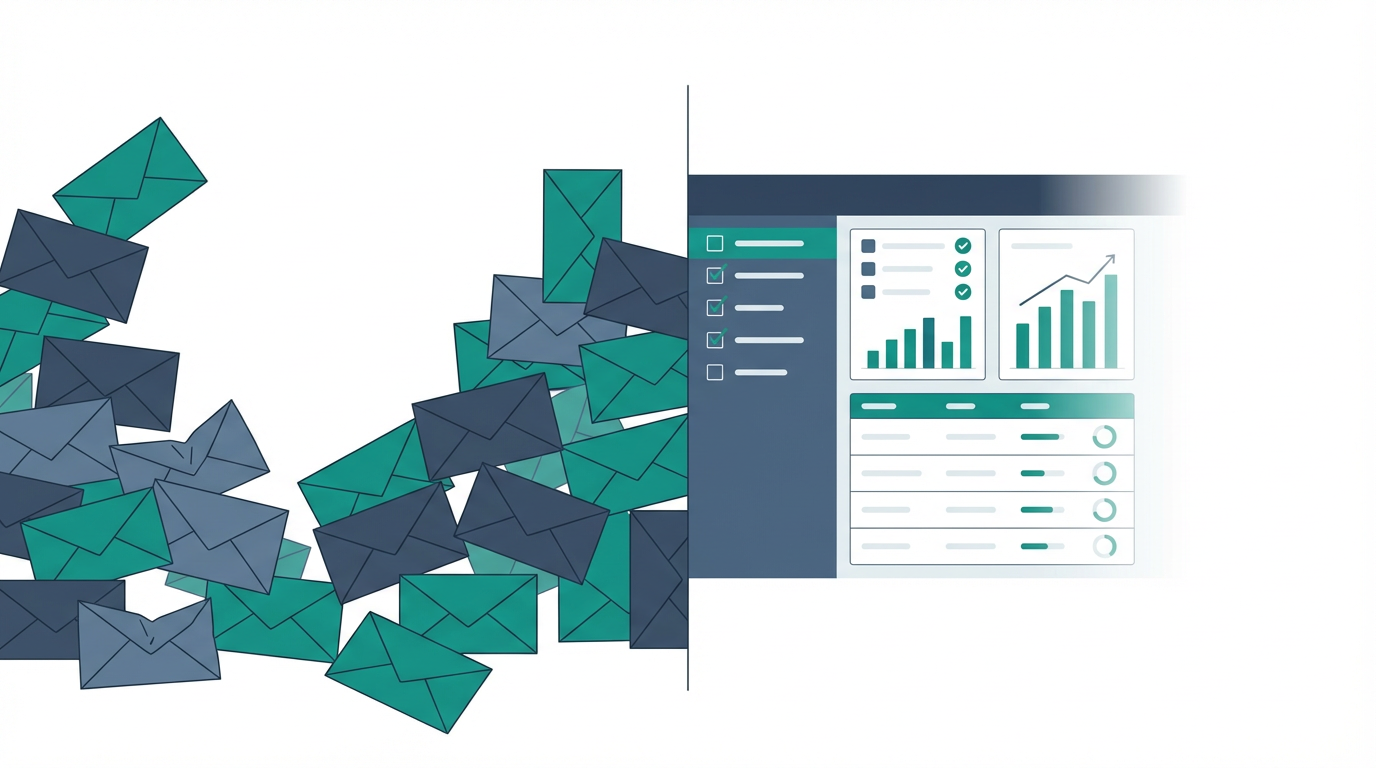
It's 9:15 on a Tuesday morning, and the shared AP inbox at a 600-bed regional health system already has 47 unread messages. By 11:00, it will have 80. By end of day, the team will have answered maybe 60. The other 40 roll into tomorrow, where they'll compete with 50 new arrivals.
Nobody tracks this number. It doesn't appear on any dashboard the CFO sees. And yet this invisible backlog quietly drives some of the most expensive operational problems in the building.
The Metrics We Track vs. The Work We Don't#
Healthcare AP departments have gotten very good at measuring invoice processing. Cost per invoice, days payable outstanding (DPO), exception rates, early-pay discount capture. These metrics get reviewed in monthly finance meetings and benchmarked against HFMA (Healthcare Financial Management Association) peers.
What nobody measures is the other half of the job: responding to vendor inquiries.
An AP customer service rep at a mid-sized hospital might handle 60 to 150 vendor emails per day. Each one requires her to read the inquiry, identify the vendor, open the Enterprise Resource Planning (ERP) system, navigate to the invoice, pull the payment status, switch back to email, compose a response, and send. Depending on the complexity of the inquiry, that cycle runs five to twelve minutes. Multiply it out and you have a team spending four to six hours a day on work that leaves no trace in any performance report.
That's not a productivity problem. That's a measurement problem. We're not tracking the work, so we can't see how much of it there is.
A Morning in the Life#
Here's what that Tuesday morning actually looks like for one AP rep. Call her Maria.
Maria arrives at 8:00. She has 38 emails that came in after she left yesterday. She starts working through them. The first three are from the same Cardinal Health AR rep asking about three different invoices. She opens the ERP, looks up each one, and crafts responses. That's 25 minutes, and she hasn't touched today's new arrivals yet.
The next email is from a vendor she doesn't immediately recognize. The email address is a generic Gmail account, the invoice number in the body doesn't match anything in the ERP, and the vendor name referenced doesn't exactly match what's in the vendor master file. She spends ten minutes figuring out that this is actually a regional division of Medline using a different billing entity than what's on record.
By 10:30, Maria has responded to 14 emails. New ones have been arriving the whole time. Her inbox now shows 61 unread.
At 11:00, the phone rings. It's a vendor who emailed last Thursday and didn't hear back. Maria apologizes, looks up the invoice on the spot while the vendor waits on hold, and resolves the issue. The call takes eight minutes. She returns to the inbox with 67 unread messages.
None of this is logged. No ticket was created. No timer was running. To every performance dashboard in the organization, this morning didn't happen.
The Hidden Consequences#
The invisibility of this work isn't just a management reporting problem. It has direct financial and operational consequences.
Credit holds that shouldn't happen. When a vendor doesn't get a response to an inquiry within a few days, they escalate. First a follow-up email, then a phone call, then an email to the procurement director. If the invoice is genuinely overdue, that escalation path ends in a credit hold, which means no new purchase orders can be processed until the account is current. A credit hold from a surgical supply vendor doesn't just affect the AP department. It affects the operating room.
Early-pay discounts that quietly expire. Many healthcare vendors offer prompt payment terms, like a 2% discount if paid within 10 days (commonly written as 2/10 net 30). Capturing those discounts requires not just processing the invoice on time, but resolving any discrepancies before the discount window closes. When the AP team is underwater on inquiry volume, disputes take longer to resolve, and discount windows expire untouched. A health system processing $200 million in invoices annually with 15% eligible for early-pay discounts is looking at $600,000 in potential annual savings. Those savings erode when the inquiry backlog makes timely dispute resolution impossible.
Vendor relationship damage that compounds over time. Large healthcare distributors like McKesson, Cardinal Health, and Medline have dedicated accounts receivable teams whose performance metrics include days outstanding on their invoices. When a hospital's AP team is consistently slow to respond, those AR teams escalate more aggressively, which creates more work for AP, which creates more backlog, which creates more escalations. The cycle feeds itself.
Staff turnover that destroys institutional knowledge. AP customer service roles in healthcare carry some of the highest turnover rates in the finance department. The work is relentless, the backlog never shrinks, and the reps feel like they're failing even when they're working hard. When an experienced rep leaves, she takes with her years of knowledge about which vendors have unusual billing patterns, which invoices are recurring issues, and which AR contacts to call when something goes sideways. That knowledge doesn't live in any system.
The credit hold cascade: a vendor emails on Day 1, gets no response, follows up on Day 3, calls on Day 5, emails procurement on Day 7, and issues a credit hold notice on Day 10. An initial response within 4 hours prevents the entire chain. The cost of that 4-hour response is measured in minutes. The cost of the credit hold is measured in days of disruption and thousands of dollars in expedited orders.
Why This Problem Doesn't Get Solved#
The reason the inquiry backlog persists isn't that AP teams are understaffed or underskilled. It's that the problem is invisible to the people who could authorize a solution.
Finance leaders see the invoice processing metrics, and those look fine. Invoices are being processed. DPO is within range. The AP department isn't flagged as a problem area.
What they don't see is the inquiry side of the house, where a team of four or five people is running a contact center operation with no ticketing system, no response time tracking, no escalation protocol, and no way to distinguish a routine status inquiry from an imminent credit hold threat. They're doing this work on top of their regular AP duties, using a shared Outlook inbox as their only tool. Vendor inquiry automation exists specifically to address this gap, but the business case for it can't be made when the problem isn't measured.
The argument for investment, whether that's more headcount, better tools, or process redesign, can't be made because the data doesn't exist to make it. The backlog is invisible, so the cost of the backlog is invisible, so the ROI of solving it can't be calculated.
The First Step: Making It Visible#
Before any technology solution, process redesign, or staffing request can be evaluated, the inquiry workload needs to be measured. Even a two-week manual exercise, a spreadsheet tracking email volume by day, inquiry type, resolution time, and escalation rate, gives an AP director the baseline data to quantify the problem.
How many inquiries does your team handle per day? How long does each one take? How many go unanswered for more than 24 hours? How many phone calls does the team receive that started as an unanswered email? How many credit holds were triggered in the last quarter, and how many of those could trace back to a delayed response?
You can't manage what you don't measure. And right now, most healthcare AP departments aren't measuring the work that consumes half their team's productive hours every day.
Once you have baseline data, you're positioned to have a real conversation about headcount, process redesign, or vendor inquiry automation that cuts per-inquiry handle time from minutes to seconds. For a framework on exactly what to measure, see the five vendor inquiry KPIs every healthcare AP team should be tracking. None of those conversations can begin without first establishing what the current state actually costs.
A quick word on tooling, while we're here. RPA does real work in AP and deserves credit for it. Three-way match against PO, receipt, and invoice. Posting coded invoices to the GL. Generating the EFT file at the end of the payment run. That's structured, rule-based work, and RPA handles it well. Vendor inquiry email is a different shape entirely. The inbound is unstructured email, the asks are mixed within a single thread, attachments need OCR before any decision can be made, and the response has to thread context back to the right vendor record in the ERP. It's not that RPA is the wrong tool. It's that the inquiry queue isn't the kind of work RPA was built for, which is why it tends to remain manual long after the rest of the AP stack is automated.
Quantify Your Inquiry Backlog
Ready to see what vendor inquiry automation looks like in practice? Request a demo and bring your shared inbox data. We'll show you how Auxtri handles the volume your team is currently managing by hand.
The backlog is invisible. That doesn't mean it isn't there.